
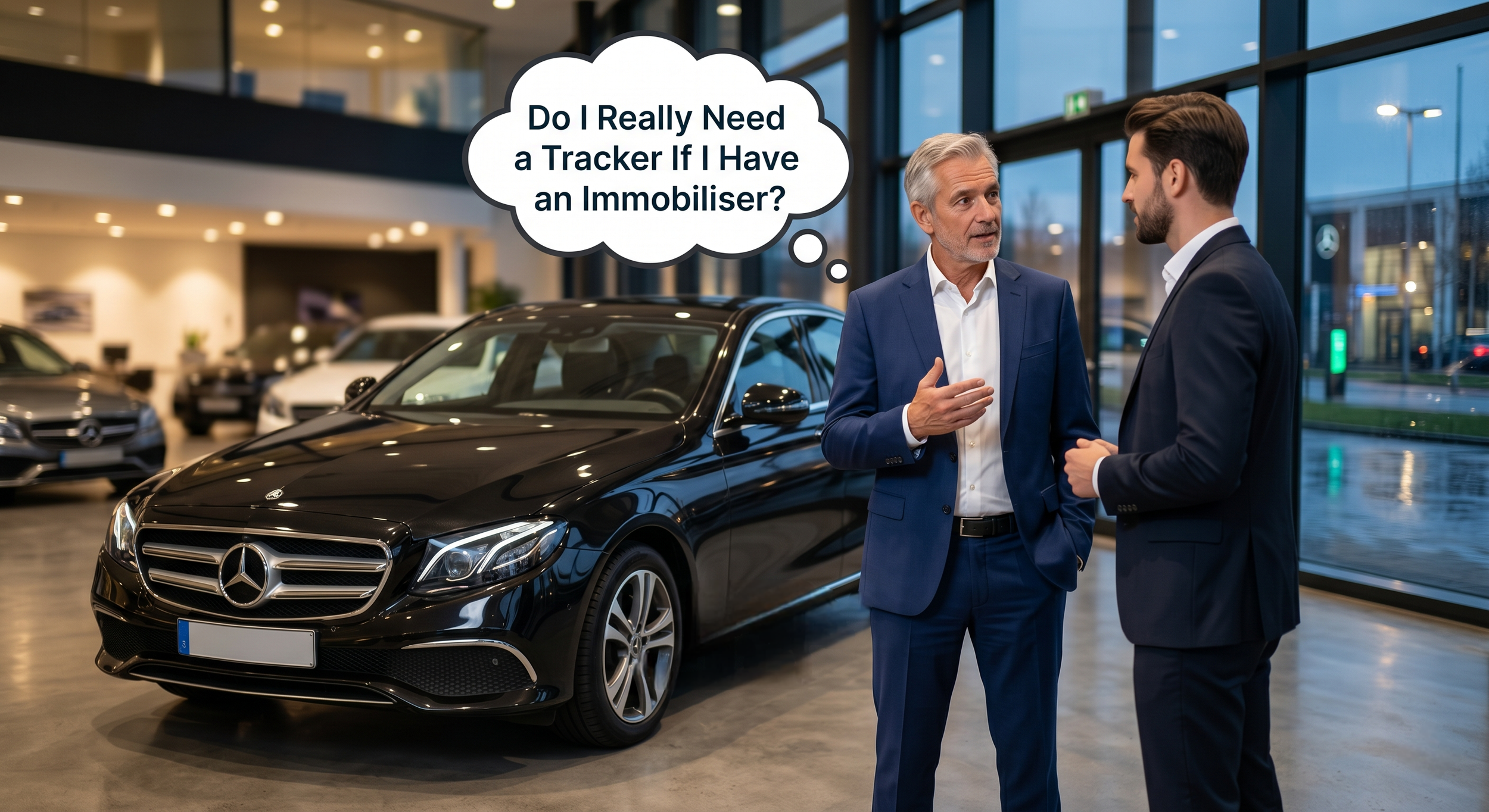
Do I Really Need a Tracker If I Have an Immobiliser?
Do I Really Need a Tracker If I Have an Immobiliser?
It is one of the most common questions we hear from customers who have just had a CAN bus immobiliser fitted. The car is protected — the engine will not start without a PIN. So why would you also need a tracker? The honest answer is that they do different things, and for many vehicle owners, doing one without the other leaves a gap in their protection.
What Does an Immobiliser Actually Do?
A CAN bus immobiliser such as the Autowatch Ghost or CAN-IMMO connects to your vehicle's CAN data network and adds a secondary authentication layer. Even if a thief successfully relays your key signal, clones your key, or obtains a replacement key from a dealer, the engine will not start without the correct PIN code or an authorised Bluetooth device.
In practical terms, an immobiliser stops your car from being driven away. It is one of the most cost effective anti-theft devices available for modern keyless vehicles, and it addresses the most common theft method — relay theft — directly.
What Does a GPS Tracker Do?
A GPS tracker does not prevent theft. What it does is track and locate your vehicle if it is moved without authorisation. Thatcham-approved S5 and S7 category trackers provide 24/7 monitoring by a professional control centre. If your vehicle is moved, the monitoring centre is alerted and can relay the live location to police.
Some trackers also offer driver recognition, geofencing alerts, and battery backup in case criminals attempt to block the signal. Higher-category trackers like S5 include additional features such as ADR (Authorised Driver Recognition), which alerts the monitoring centre if the vehicle moves without an authorised driver present.
So What Happens Without a Tracker?
With only an immobiliser fitted, you are well-protected against your car being driven away. However, a determined criminal may still attempt to steal your vehicle in the following ways:
• Loading it onto a flatbed recovery truck and transporting it to another location for later work.
• Towing or pushing away to strip for parts or attempt to bypass the immobiliser
In these scenarios, a GPS tracker provides the critical recovery capability that an immobiliser alone cannot offer. Even if your car is moved without the engine running, the tracker continues to transmit its location.
What Happens Without an Immobiliser?
With only a tracker fitted, your car can still be stolen via modern theft technology’s — and may be gone before the monitoring centre can alert police. Recovery rates for stolen vehicles vary significantly depending on how quickly police can respond. By the time a tracker alert is received and acted on, a vehicle can already be in a compound, a shipping container, or across the county border.
A tracker without an immobiliser is a recovery tool. An immobiliser without a tracker is a prevention tool. Used together, they provide prevention and recovery — the most comprehensive protection available.
Which Should I Prioritise?
If your budget is limited, an immobiliser should be your first investment. Stopping the theft from happening is always preferable to recovering a vehicle that has already been taken — which may have sustained damage during the theft or been stripped of components.
However, if you own a high-value vehicle, a vehicle that is frequently targeted in your area, or a vehicle required by your insurer to have a tracker, adding a GPS tracker alongside your immobiliser provides the most complete protection layer.
What Do Insurers Say?
Some insurers — particularly for high-value vehicles such as Range Rovers, Land Rovers, and prestige German makes — now require or strongly recommend a Thatcham-approved tracker or a TASSA approved immobiliser as a condition of cover. Others offer premium discounts for approved security devices. Fitting both an immobiliser and a tracker often results in the greatest reduction in premiums.
It is worth contacting your insurer directly to understand what devices they recognise and what discounts may be available.
The Short Answer
You do not have to choose. An immobiliser stops your car from being stolen. A tracker helps get it back if the worst happens. For maximum protection, the two work best together — and many of our customers opt for a combined installation for exactly this reason.
Talk to Us About Combined Security Solutions
We install Autowatch Ghost immobilisers, CAN-IMMO devices, and Thatcham S5/S7 GPS trackers across Kent, London, Essex, Surrey, and Sussex. Our mobile installation service means we come to you. Get in touch to find out which combination is right for your vehicle.
View our products at www.idealas.co.uk/products
Relay Theft Explained: How Criminals Steal Keyless Cars (And How to Stop Them)
Relay Theft Explained: How Criminals Steal Keyless Cars (And How to Stop Them)
Car theft in the UK has changed dramatically over the past decade. Gone are the days when thieves needed to smash a window or hotwire an engine. Today, some of the most sophisticated vehicle thefts happen in seconds — silently, without breaking a single lock — while your keys are sitting on your hallway table.
This is relay theft, and it is now one of the most common methods used to steal modern keyless vehicles in the UK. In this guide, we explain exactly how it works, which vehicles are most at risk, and what you can do to protect your car.
What Is Relay Theft?
Relay theft is a type of vehicle theft that exploits the keyless entry and keyless start systems found on most modern cars. These systems work by emitting a short-range radio signal from your key fob. When your key is close to the car, the vehicle detects the signal and unlocks automatically — no button press needed.
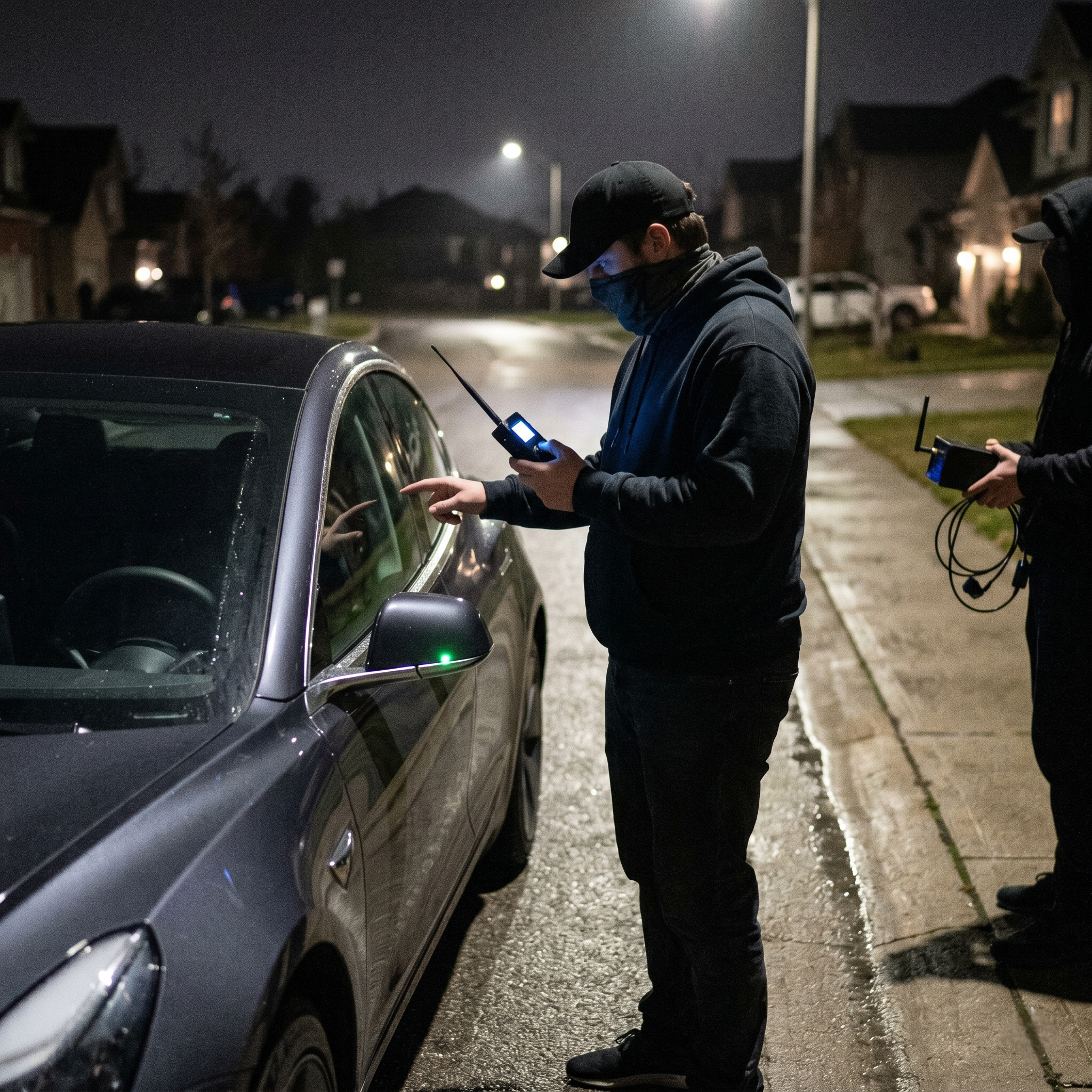
Criminals have found a way to replicate this proximity. Using two small electronic devices — often no bigger than a mobile phone — they can amplify and relay your key’s signal across much greater distances than it was designed to travel.
How Does Relay Theft Work? Step by Step
Here is how a typical relay theft takes place:
Step 1: Thief 1 approaches your front door
One criminal stands near your home — close enough for their relay device to detect the faint signal from your key fob inside.
Step 2: The signal is captured and amplified
Their device picks up your key’s signal and transmits it wirelessly to a second device held by their accomplice near your car.
Step 3: The car is fooled
Your car receives the amplified signal and believes your key is nearby. It unlocks the doors and enables the ignition.
Step 4: The car is driven away
The second criminal gets in, starts the engine, and drives off. The entire process can take under 60 seconds.
Step 5: The car disappears
Once the relay devices are switched off, the car is effectively locked and the ignition disabled — but the thieves have usually already reached a safe location or a chop shop by then.
Which Cars Are Most Vulnerable?
Almost any vehicle with keyless entry and keyless start is potentially at risk. However, some models attract disproportionate attention from thieves due to their resale value or demand for parts. In the UK, these include:
• Land Rover Defender and Range Rover
• BMW 3 Series and 5 Series
• Mercedes C-Class and E-Class
• Ford Focus and Ford Kuga
• Volkswagen Golf
• Toyota RAV4
• Audi A4 and Q5
It is worth noting that relay theft is not limited to premium vehicles. Any car with a passive keyless entry system — where the car unlocks as you approach — is a potential target.
How Common Is Relay Theft in the UK?
Relay theft has become one of the dominant methods of vehicle theft across the UK, particularly in urban and suburban areas. Police forces in London, the South East, and the Home Counties — including Kent, Essex, and Surrey — have reported consistent rises in keyless vehicle theft over recent years.
The majority of relay thefts occur at night, targeting vehicles parked on driveways or residential streets. In many cases, homeowners are completely unaware the theft has taken place until they look out of the window the following morning.
How to Protect Your Car From Relay Theft
The good news is that relay theft is entirely preventable. Here are the most effective methods, from the simple to the comprehensive.
1. Use a Faraday Pouch (Basic Protection)
A Faraday pouch is a signal-blocking case that prevents your key fob from transmitting any signal. They cost as little as £10 and are widely available. However, they only work if you consistently remember to use them — and they offer no protection if the key is left anywhere other than inside the pouch.
2. Install a CAN Bus Immobiliser (Highly Effective)
A CAN bus immobiliser such as the Autowatch Ghost or CAN-IMMO connects directly to your vehicle’s CAN data network — the communication system that controls all major vehicle functions. Even if a thief successfully relays your key signal and unlocks the car, the immobiliser prevents the engine from starting without an additional PIN code or authorised device.
Because CAN bus immobilisers emit no radio frequency signal of their own, they cannot be detected by relay scanning equipment. There is no visible indicator, no flashing light, and no way for a thief to know the device is even fitted. Installation is discreet, with the device hidden within the vehicle’s wiring.
This is currently one of the most effective countermeasures available against relay theft, and is recommended by many UK insurers.
3. Add a GPS Tracker (Recovery Layer)
A GPS tracker does not prevent theft, but it dramatically increases the chances of recovering your vehicle if it is stolen. Insurance-approved Thatcham S5 and S7 trackers provide 24/7 monitored tracking with immediate alerts if your vehicle is moved without authorisation.
For maximum protection, many customers combine a CAN bus immobiliser with a tracker. The immobiliser makes the car extremely difficult to steal; the tracker provides a safety net if a theft is somehow attempted.
4. Physical Deterrents
Visible deterrents such as steering wheel locks, driveway posts, and CCTV cameras can discourage opportunistic thieves. While they won’t stop a determined criminal, they increase the time and risk involved — and thieves typically prefer easier targets.
What About Key Cloning?
Key cloning is closely related to relay theft but involves copying your key’s unique signal to create a duplicate. This is more common with older vehicle systems, but some criminals use hybrid approaches — using relay equipment to steal the vehicle initially, then using the drive time to clone the key for future access.
CAN bus immobilisers protect against key cloning for the same reason they protect against relay theft — even with a cloned key, the engine cannot be started without the secondary authentication.
Summary: Your Relay Theft Protection Checklist
• Store your keys in a Faraday pouch, away from doors and windows
• Consider a CAN bus immobiliser such as the Autowatch Ghost or CAN-IMMO for reliable engine protection
• Add an insurance-approved GPS tracker for monitored recovery capability
• Use visible deterrents as an additional layer
• Speak to your insurer — some now require or offer discounts for approved security devices including TASSA.
Protect Your Vehicle With Ideal Auto Security
We supply and install CAN bus immobilisers, GPS trackers, and alarm systems across Kent, London, Essex, Surrey, and Sussex. Our mobile installation service means we come to your home or workplace — no need to travel to a garage.
If you’d like to discuss the right level of protection for your vehicle, get in touch with our team today.
View our products at www.idealas.co.uk/products